
TECH
The Vivir Latency Gap - What 2026 Benchmarks Mean for Juegos de CCTV Stream Design
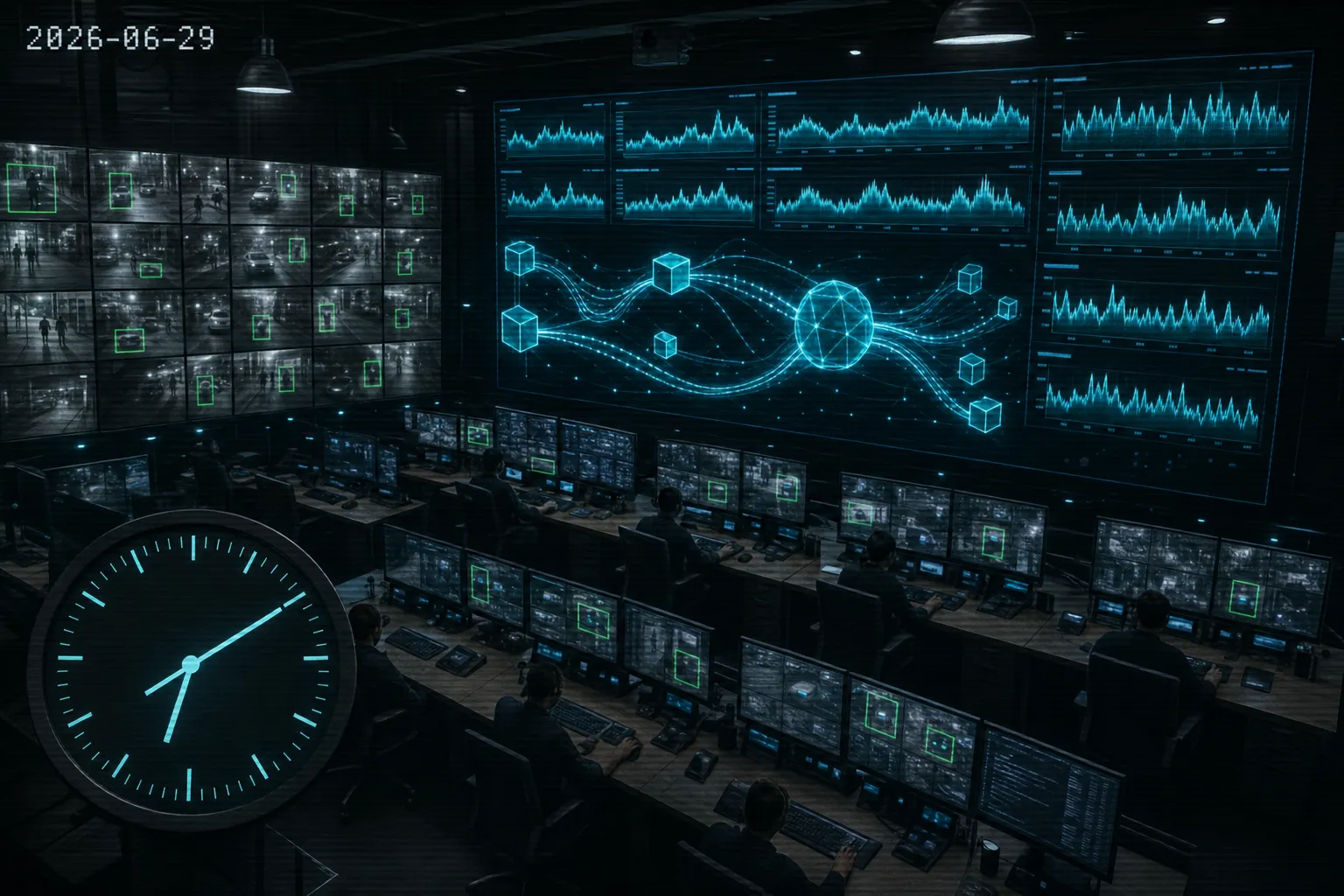
Fresh 2026 latency data from live dealer studios pegs end-to-end stream delay at 1.5 to 2.5 seconds. CCTV games have a fundamentally different timing problem - proof-frame integrity, not action latency.
Información fuente
Estado: Editorial
Fuente principal: equipo editorial de cctvgames.global
Last updated: 2026-06-29
Fresh 2026 latency data from live dealer studios pegs end-to-end stream delay at 1.5 to 2.5 seconds across the major providers - encode 200 to 300ms, CDN 250 to 350ms, decode 100 to 200ms, con mobile adding 200 to 500ms on top. That number matters for blackjack and roulette because it sets the cash-out window. For CCTV games it is a different problem entirely. The category does not bet on a moving wheel - it bets on whether the AI counter agrees with the footage. The latency target is not "fast enough to react", it is "tight enough that proof-frame integrity survives the round close".
The 2026 live dealer latency baseline
A May 2026 technical breakdown from Wholly Smoked measured end-to-end latency at 1.5 to 2.5 seconds across Evolution, Pragmatic Play Vivir and Playtech streams on home fibre - encoding contributes 200 to 300ms, CDN propagation 250 to 350ms, client-side decode 100 to 200ms. Móvil data networks add another 200 to 500ms, per the same source's field tests. A separate CasinoAlpha review from June confirms the mobile gap.
Evolution disputes the upper end. Its in-house G-Engine, marketed in supplier briefings, targets sub-150ms studio-to-edge for premium tables. A handful of providers tracked by Kodedice in June claim sub-one-second end-to-end in tuned deployments. The honest read is that the 1.5 to 2.5 second window is what most players see on most tables most of the time.
Why CCTV games have a different latency problem
Vivir dealer needs the player to make a decision while the round is open. A two-second lag on blackjack hit-or-stand is recoverable, a two-second lag on roulette no-more-bets is awkward but workable. The genre is built around the assumption that the operator can show the player live-enough video to feel present at the table.
CCTV games do not work that way. As we covered in the video pipeline breakdown, the round resolves on a server-side AI count over a fixed time window, not on a player input during the stream. The latency question changes shape - it is no longer "can the player react in time", it is "do the frames the player saw match the frames the AI counted, y can the timestamp prove it".
That is proof-frame integrity. The stream the player watches has to be the same footage the count is run against, con synchronised timestamps tight enough that any dispute resolves on a single frame. Two and a half seconds of decode lag on the viewer side is irrelevant if the server-side count is run on the master feed - what matters is that the round-close timestamp on the player's screen lines up with the round-close timestamp in the count log.
What the WebRTC versus LL-HLS choice actually buys
For live dealer the WebRTC versus LL-HLS trade-off is real - WebRTC under one second for competitive play, LL-HLS two to five seconds for sports betting. For CCTV games the trade-off changes meaning. WebRTC's main benefit is that it gives the player a stream that is closer to live, which makes the count feel less like an oracle and more like a verifiable event. LL-HLS's main benefit is buffer headroom, which lowers the chance of a mid-round glitch on the player's screen.
The right pick depends on the game. Hora punta on a busy intersection produces a high-density count where viewer stutter would be a real problem - LL-HLS with three seconds of buffer keeps the visual evidence clean. río pato has a slower count and a quieter feed - WebRTC's tighter window helps players trust what they are seeing. carrera de nieve sits in between.
What this means for the next twelve months
Two things to watch. First, whether the 155.io engine ships a configurable latency profile per location feed - the technical case for it is now well-documented in the live dealer space y el player-trust case is stronger for CCTV games than it is for blackjack. Second, whether dispute-handling documentation starts to lean on proof-frame timestamps as the canonical source of truth, the way CCTV games work already implies it should.
The live latency arms race is happening at the studio end. The CCTV games version of it is quieter, slower, y more interesting - it is about getting the proof layer right, not about shaving milliseconds off the deal. The AI engine y el RTP and house edge work was the first conversation. Latency and proof-frame integrity is the second.
Apostar, robet and Barajar all carry the full 155.io catalogue and run the same proof-frame infrastructure under the hood. arrasado carries Hora punta only. Pick a feed, watch a round, then watch the count log if the operator exposes one. Responsible play applies in full - the format is fast, the rounds are short, set a session limit before you start.
El juego implica riesgos: nunca apueste más de lo que puede permitirse perder.
Más noticias