REGULATION
How the UK's New Game Design Rules Actually Suit CCTV Games (And Hurt Slots More)
The UKGC's January 2025 design overhaul banned turbo features, autoplay, and sub-five-second spin cycles - changes that read like a blueprint for the kind of game CCTV titles already were.
Source Information
Status: Editorial
Primary source: cctvgames.global editorial team
Last updated: 2026-05-21
The Gambling Commission's January 2025 overhaul of remote game design rules was framed as a slot industry problem. Sixteen months on, the more interesting story is what it did to the relative position of new categories. CCTV games came out of the rewrite looking less like a regulatory risk and more like an example product.
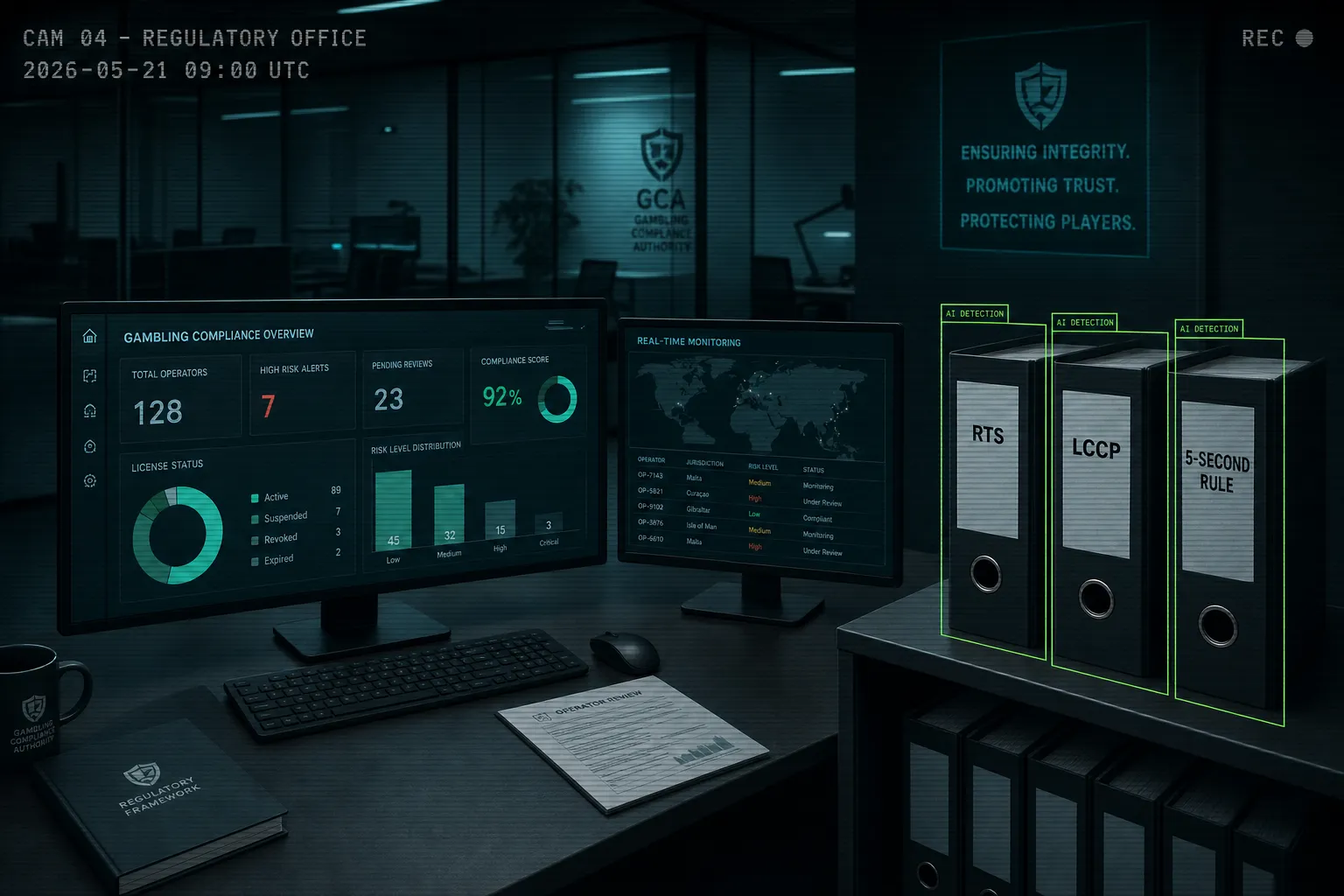
The big six changes that came in on 17 January 2025 are now baked into UK operator licences - and were updated again on 31 October 2025 with a new financial-limits prompt. The Gambling Commission's own announcement lays out the headline list: no turbo or slam-stop features, no autoplay, no celebrations of returns less than or equal to stake, no operator-led simultaneous play, and a hard floor of five seconds between casino game cycles.
Read the list with a CCTV game in mind
Now run it back against how a Rush Hour or Snow Run round actually works. There is no turbo button. There is no slam-stop. There is no autoplay. There is no false-win celebration, because the game's outcome is a literal count rendered visually on a real video feed - nothing to fake. And the round length is dictated by the camera, not the engine, which means cycle times sit well north of the five-second minimum. The whole thing is, by accident or design, RTS-compliant out of the box.
Wiggin's legal write-up notes that the spin-stop ban explicitly carves out "games in which a player will lose their stake unless they take action to end the game" - language that maps almost word for word onto how a CCTV bet is settled when the cars finish crossing the line.
What it changed for slots
Slots had to be rebuilt around the new rules. As Bird & Bird summarised at the time, the slots industry was already subject to a 2.5-second minimum cycle. The casino-wide bump to five seconds, combined with the autoplay ban, cut hourly bet volume on table-style products by a meaningful margin. Chambers' 2025 UK gaming-law review also notes that online slot stakes were capped in April and May 2025 at GBP5 per spin for over-25s and GBP2 for under-25s.
CCTV games sit outside the slots stake cap entirely. They are classed as casino games, which means they fall under the wider RTS rules but not the slot-specific limits. That is a genuinely meaningful regulatory edge.
What it means for operators ranking the category
This is one reason Stake, Roobet and Shuffle keep Rush Hour and Snow Run front and centre in their UK-facing marketing - the products travel cleanly. The compliance team does not have to ask the studio to strip features. The reporting fields that the new rules require - net position, time elapsed, single-product play - are already how a CCTV game session is structured. One feed, one count, one outcome, no parallel tables.
The next regulatory wave to watch is the 19 January 2026 changes to bonus rules. iGamingCare's breakdown confirms wagering requirements are now capped at 10x and operators can no longer offer cross-product bonuses that mix casino, sports, and bingo into a single incentive. Operators promoting CCTV games will need to keep their bonus mechanics single-product, which suits a category that already lives in its own vertical.
The takeaway
None of this makes CCTV games safer to play recklessly. The house edge does not move. The point is narrower - regulators wanted slower, fairer, more transparent casino products, and they got a category that, structurally, was already running at the speed of real-world traffic. The Responsible Play guide has the deposit limits and timeout tools worth using regardless of which category you favour.
More News