TECHNOLOGY
Detection Is the Easy Part - Why Multi-Object Tracking Is the Real AI Engine Under CCTV Games
The AI inside a CCTV Game is not the detector that labels a car. It is the tracker that decides the car on frame 12 and the car on frame 47 are the same car. A read on the 2026 tracker generation - BoT-SORT, SAM 3.1, NOOUGAT, Roboflow trackers v2.6.0 - and what it means for the integer the round settles on.
Source Information
Status: Editorial
Primary source: cctvgames.global editorial team
Last updated: 2026-09-03
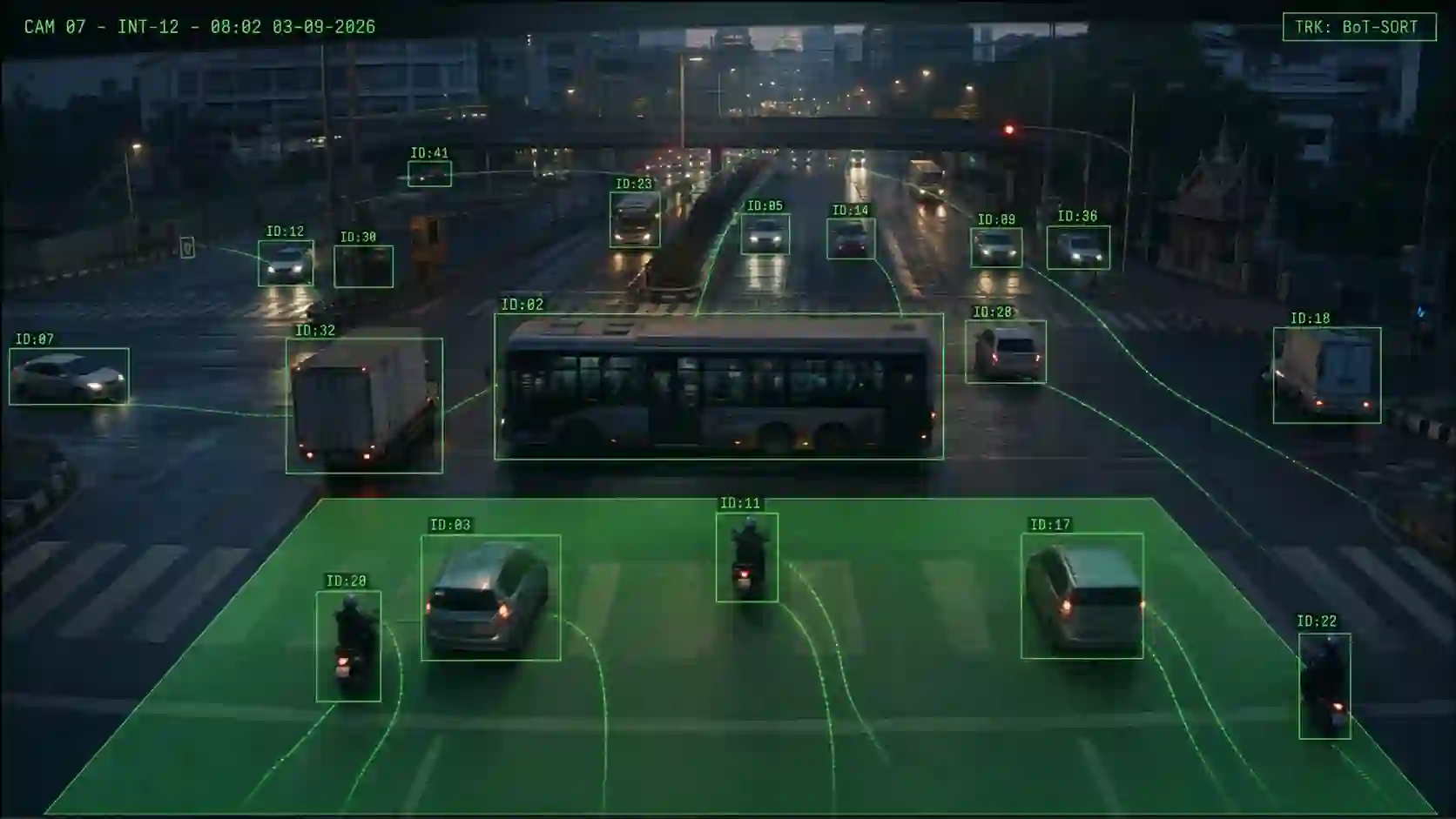
The AI in a CCTV Game is not the box that says CAR. It is the code that decides the CAR on frame 12 and the CAR on frame 47 are the same CAR. Detection labels a shape. Tracking settles the round. And 2026 has been the year the tracking half of the pipeline got its own generation of models.
Every 155.io title advertises AI-powered object counting. The counter is the visible part. Underneath, the same technical loop runs on all three games. Frame in, detector runs, boxes come out, tracker links boxes across time, counts increment only when a linked track crosses the detection line. If the tracker fails, a bus that briefly hides a truck comes out as two trucks. That is the difference between a fair round and a payout dispute.
Detection has been mostly solved
Detection is the easier problem and it has been getting cheaper by the year. Ultralytics YOLO26, released January 2026, runs an NMS-free end-to-end predictor, spans nano to extra large, and is up to 43% faster on CPU than YOLO11. Roboflow's RF-DETR pushes higher accuracy at slightly higher latency. For a CCTV feed of an intersection, either model can bound the vehicles in every frame at real-time speed. That part of the game is a commodity.
Tracking is where the round is actually decided
Multi-object tracking is what turns per-frame boxes into a stable count. It has to survive brief occlusions, keep IDs consistent when a car changes lanes, and avoid re-ID collapse when two similar vehicles pass close together. The Ultralytics tracker family currently ships six algorithms: BoT-SORT, ByteTrack, OC-SORT, Deep OC-SORT, FastTracker, and TrackTrack, with different motion models, appearance re-identification options, and occlusion recovery strategies.
The gap between them is not academic. On the Roboflow MOT benchmark, BoT-SORT posts HOTA 63.7, IDF1 78.7, MOTA 79.2 against ByteTrack's 60.1, 73.2, and 74.1. On a 55-second Rush Hour round with 30-plus vehicles crossing the zone, those points translate directly into whether an Over 20 bet resolves at 21 or 19.
The 2026 tracker wave
Two releases this summer are worth watching for the category. Meta's SAM 3.1 ships object multiplexing that tracks up to sixteen objects in a single forward pass, a real-time efficiency upgrade rather than a new benchmark king. The NOOUGAT paper proposes a unified online-and-offline tracker built on a graph neural network with an autoregressive long-term layer, and reports online AssA gains of +2.3 on DanceTrack, +9.2 on SportsMOT, and +5.0 on MOT20 against prior state of the art. SportsMOT is the closest public benchmark to what a CCTV Game actually looks like: many similar-looking objects, fast motion, partial occlusion.
On the tooling side, Roboflow's open-source trackers library hit v2.6.0 on 3 August 2026 and now sits at roughly 70,000 PyPI installs per month. Detector-agnostic tracking is now a two-line change in production code, which means small operators can iterate as fast as 155.io.
Why the round-level player should care
A CCTV round pays or does not pay based on a single integer at settlement. That integer is generated by a tracker, not a detector. If your operator upgrades from ByteTrack to BoT-SORT the observed variance on Range and Under bets changes, because tighter ID persistence shifts the count distribution towards the true street count. The house edge does not move. The realised outcome path does.
None of this is on the marketing sheet. The guides hub and the live-vs-recorded feed explainer are the closest the category has come to publishing what actually runs under the counter. The rest is inferred from what the industry publishes elsewhere, which in 2026 has been a lot.
More News