
PSYCHOLOGY
The Illusion of Control: Why Watching Real Footage Feels Like Skill, and Isn't
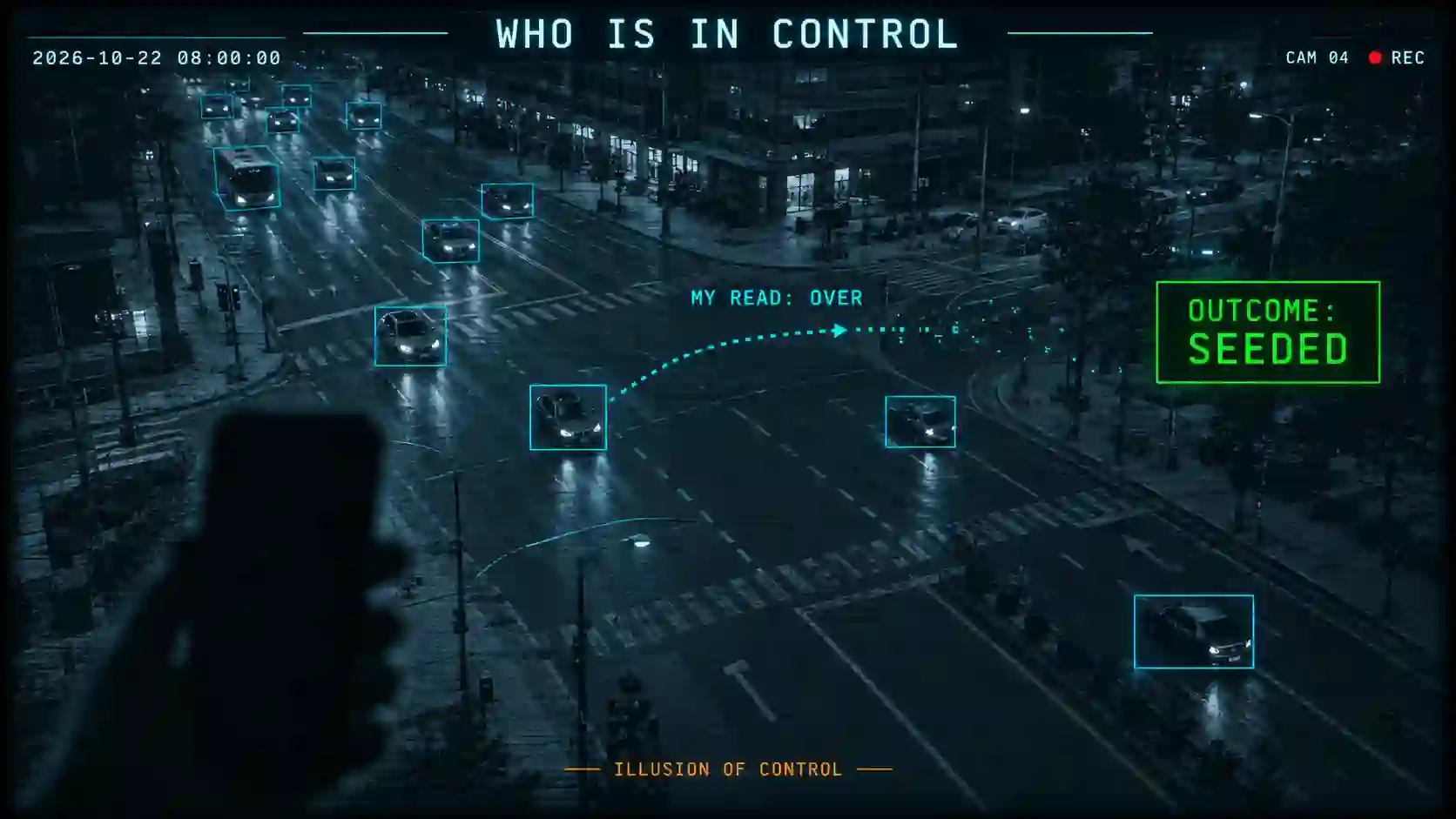
CCTV games hit all four of Ellen Langer's illusion-of-control triggers: choice, involvement, familiarity and competition. Research on skill-styled gambling machines shows identical payouts still breed skill beliefs, which track with higher problem-gambling scores. The round is drawn from a seed, so your read of the traffic never enters the maths.
Source Information
Status: Editorial
Primary source: cctvgames.global editorial team
Last updated: 2026-10-22
CCTV games may be the most convincing illusion of control the gambling industry has built. You watch a real junction, spot a bus queue forming, and feel like you know something. You don't. 155.io's own rules say the winning bet is drawn from a random seed before the count, and the lines are then placed around whatever the AI sees. Psychologists have a name for the gap between how much you think you know and how much it matters, and 50 years of research says it costs money.
The oldest trick in the book
In the 1970s, the psychologist Ellen Langer showed that people treat chance like skill when a game gives them the right cues. A review in Addiction by Luke Clark and Michael Wohl sets out her four triggers for this "skill-chance confusion": choice, involvement, competition and familiarity.
The effect is not small. In one of Langer's studies, people who picked their own lottery ticket wanted $8.67 on average to sell it back, against $1.96 for people who were handed one. Clark, at the University of Cambridge, puts it plainly: gambling games promote "the belief that the gambler can exert skill over an outcome that is actually defined by chance", according to Cambridge's research summary.
All four triggers, on one screen
No study has tested CCTV games yet. But it is hard to design a format that hits Langer's list more neatly.
- Choice. You pick Under, Range, Over or Exact. Picking feels like deciding.
- Involvement. You watch the AI boxes lock on and the count tick up, live, as if you are tracking it with them.
- Familiarity. You know what traffic looks like. A Rush Hour feed from London or Tokyo feels readable in a way a slot reel never does.
- Competition. Streamers call the count out loud, and chat argues about it. It feels like a contest you can win by reading better.
What the evidence says about "fake skill"
The closest research is on skill-based gambling machines, which add video-game controls to a chance-based payout. In a 2024 study of 1,260 adults in the Journal of Behavioral Addictions, Matthew Rockloff and colleagues gave players either a torpedo-firing game or a standard reel machine with identical payouts.
The result: "Despite identical payout structures, people assigned to play SGM showed greater illusions of control, believing in the influence of skill on game outcomes and that practice could improve results." The skill-style game also appealed most to younger adults and people with more gambling problems.
The beliefs carry risk. A 2026 Journal of Gambling Studies paper on 1,311 adults found that stronger skill and strategy beliefs went with higher problem-gambling scores.
Why the footage is not information
Here is the part the screen does not show you. In Rush Hour, Duck River and Snow Run, the round's outcome is drawn from a seed committed before betting closes, as we explained in how a CCTV round is decided. A busy junction does not make Over more likely. Under wins about as often as it is priced to, whatever the traffic.
The camera is real. Your read of it simply does not enter the maths. That is fair, and it is also why every bet type returns 90% in the long run.
Three checks before you play
- Catch the thought. If you hear yourself say "this junction always runs Over", that is the illusion talking.
- Set the limit before the feed. Decide your stake and stop point before the first camera loads, not after a "good read".
- Watch for the practice trap. Getting better at watching does not mean getting better at winning. Our near-miss explainer covers the related "nearly had it" feeling.
Enjoy the show as a show. For limits and support, read our responsible play guide.
Related Game
Rush Hour
Real-world traffic prediction - Urban intersections worldwide
Read Full GuideMore News