
PSYCHOLOGY
Fast Rounds and the Evidence: What European Gambling Harm Awareness Week 2026 Says About CCTV Games
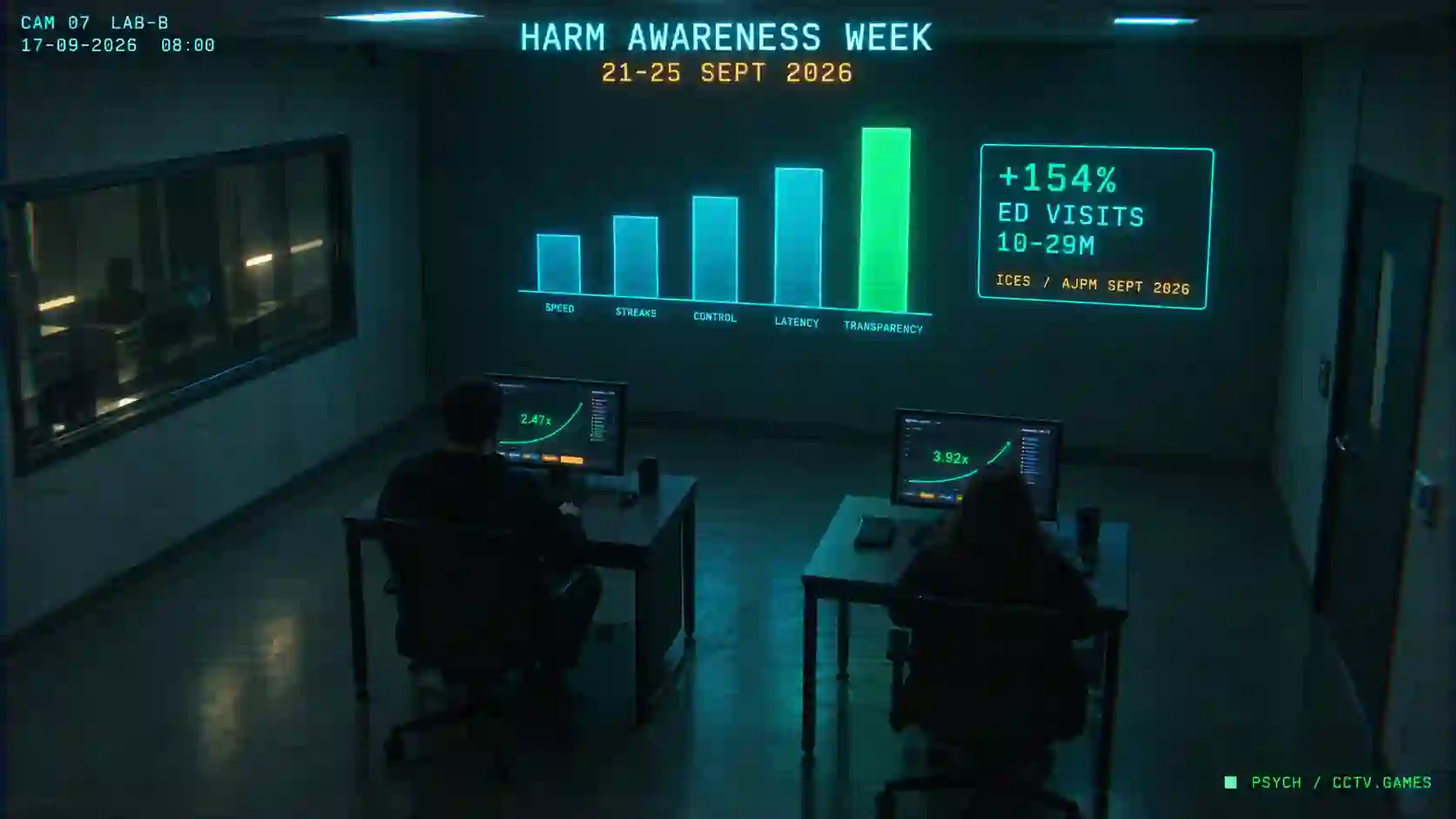
The European Gambling Harm Prevention Network's awareness week runs 21 to 25 September with new and emerging forms of gambling as the theme. It arrives alongside a September ICES study in the American Journal of Preventive Medicine showing gambling-disorder emergency visits doubled in Ontario after the province opened its online market, and January data comparing crash and blackjack risk behavior. Fast-round games sit inside this frame. Transparency during the round is the intervention with the best evidence right now.
Source Information
Status: Editorial
Primary source: cctvgames.global editorial team
Last updated: 2026-09-17
The European Gambling Harm Prevention Network's awareness week runs 21 to 25 September, and this year the theme is "new and emerging forms of gambling" with prediction markets and crypto casinos named as headline topics. It arrives the same month the American Journal of Preventive Medicine published an ICES study showing gambling-disorder emergency visits doubled in Ontario after the province opened its online market. Fast-round games sit right in the frame the week is drawing. That includes ours.
CCTV Games are not slots. They are not sports. They are a fast-round product, and the harm research that touches fast rounds touches this category too. Being honest about that is more useful than pretending the label protects us.
What the September data says
The ICES team tracked 14 years of Ontario emergency department records covering 757 people and 952 gambling-disorder visits. After Canada legalised single-event sports betting in 2021 and Ontario opened its regulated online market in 2022, visits were 154 percent higher than the pre-legalisation trend among males aged 10 to 29 and 116 percent higher among males 30 to 44. Female rates did not change. More than 70 percent of the visits involved another mental health condition or heavy substance use. Nearly a third ended in hospital admission.
That is a supply-side story. Give more people faster access to more products and the harm curve moves.
The crash-style pattern
A January BlackJackReview study is the sharpest look yet at fast-round risk behaviour, comparing crash, dice and blackjack. During streak sequences, crash players bet 27 percent more aggressively than blackjack players. PGSI drift over six months came in at 15 percent for crash versus 4 percent for blackjack. Volatility and loss ratios ran highest in crash across the sample. The paper attributes most of the gap to two features that CCTV Games share by construction: a live decision under time pressure, and a cash-out button that lets the player believe they controlled the outcome.
What actually moved the numbers
The same study tested a transparency condition, and the results were unusually large for gambling-harm research. When a visible house-edge display was on screen during play, risk-escalation events fell 27 percent, mean bet size fell 18 percent and PGSI drift dropped 36 percent over six months. Session length only fell 16 percent. Players kept playing. They just played less recklessly.
That is the finding worth carrying into product decisions. Length limits and forced breaks have a mixed evidence base. Making cost visible during the round has a strong one.
What a 40-second round means for us
CCTV Games run around 30 to 40 seconds per round. That is slower than crash and much slower than a slot spin, and the round structure forces a real-world event to unfold before resolution. Neither buys us out of the fast-round conversation. It changes the levers.
The round timeline already shows the odds movement during the betting window. Adding a running "estimated cost per hour at your current stake pace" line during the between-round idle would apply the transparency finding directly. So would surfacing a session-cost total the moment a player hits a self-set threshold. Neither adds latency to the pipeline. Both fit inside the live envelope we already ship.
Awareness Week 2026 is a good moment to say out loud what the research already suggests. Fast rounds carry real risk. Transparency inside the round is the intervention with the best evidence right now. Everything else is a distant second.
More News